
Revelation Journey · Revelation 21:1–8
A New Heaven and a New Earth
John sees a new heaven and a new earth. The first heaven and the first earth have passed away, and the sea is no more.
Then John sees the holy city, New Jerusalem, coming down out of heaven from God.
The city is prepared like a bride beautifully dressed for her husband.
A loud voice comes from the throne.
The voice announces that God's dwelling is now with humanity.
God will dwell with His people. They will belong to Him, and God Himself will be with them.
He will wipe away every tear from their eyes.
Death will be no more. There will be no more mourning, crying, or pain.
The former things have passed away.
The One seated upon the throne declares that He is making all things new.
John is told to write these words, because they are faithful and true.
The One on the throne declares that it is finished.
He identifies Himself as the Alpha and Omega, the Beginning and the End.
He promises to give freely from the spring of the water of life to anyone who thirsts.
Those who overcome will inherit these blessings.
God promises to be their God, and they will be His children.
But the vision also includes a solemn warning about unbelief, wickedness, and the second death.
The new creation is presented as God's final answer to death, suffering, and the brokenness of the former world.
What is the new heaven and new earth?
John describes a new heaven and a new earth after the former heaven and earth have passed away.
The passage presents a transformed order in which God dwells with His people and death and suffering are removed.
Christians differ on whether this describes the complete replacement of the former creation or its renewal and transformation.
The central promise is that God makes all things new.
Why does John say the sea is no more?
Revelation 21:1 says the sea is no more.
Some Christians understand this literally, as a feature of the new earth.
Others understand the sea symbolically, because the sea can represent chaos, danger, or separation in biblical imagery.
Revelation does not fully explain the statement here.
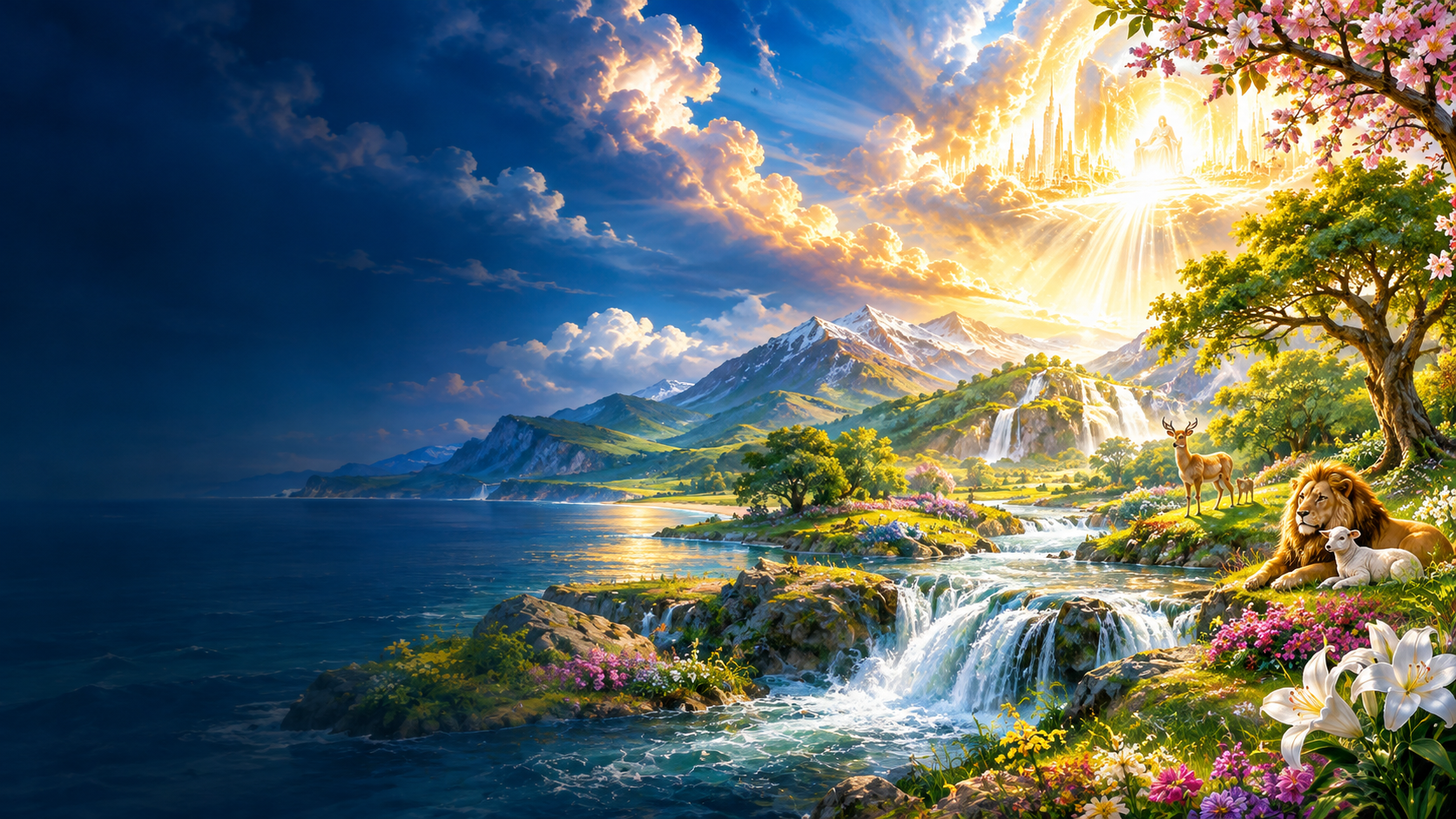
The artwork includes a large body of water as an artistic landscape choice. It should not be taken as a literal depiction of Revelation 21:1.
What does it mean that God dwells with humanity?
The voice from the throne announces that God's dwelling place is with humanity.
The promise recalls God's presence with His people throughout Scripture.
In the new creation, that relationship is described as direct and enduring.
The emphasis is not merely on a beautiful place, but on God's presence with His people.
Will there really be no more death or pain?
Revelation 21:4 explicitly promises that death, mourning, crying, and pain will be no more.
This is one of the central promises of the new creation.
The passage does not provide a scientific description of how this will occur.
It presents the promise as the work of God Himself.
What is the water of life?
God promises to give freely from the spring of the water of life to the thirsty.
This imagery communicates God's gift of life and renewal.
The river of the water of life appears in greater detail in Revelation 22:1–2.
The promise emphasizes that life is given freely by God.
What warning appears in verse 8?
Revelation 21:8 includes a warning concerning those characterized by unbelief, cowardice, murder, sexual immorality, sorcery, idolatry, and falsehood.
The passage connects these descriptions with the lake burning with fire and sulfur, called the second death.
Christians differ in how they understand the relationship between repentance, forgiveness, perseverance, and final judgment.
The warning is part of the passage and should not be omitted when presenting John's vision.
Pause and notice
What does John see after the first heaven and earth pass away? What city comes down from heaven? Who will dwell with humanity? What four kinds of suffering will disappear?
Look back at the passage
John sees a new heaven and a new earth. New Jerusalem comes down from God. God Himself dwells with His people. Death, mourning, crying, and pain will be no more.
Explore the Scripture and artwork
The illustration presents a peaceful, renewed world filled with light, flowering plants, flowing water, and animals at rest.
Revelation 21:1–8 describes a new creation, God's presence, and the end of death and suffering.
The lion and lamb, peaceful animals, mountains, waterfalls, and flowers are artistic choices inspired partly by other biblical visions of peace, including Isaiah 11.
Revelation 21:1–8 does not specifically describe these animals or landscapes.
The glowing heavenly city in the distance anticipates the New Jerusalem, which John describes in greater detail later in Revelation 21.
The painting is intended to communicate the hope of renewal, not to establish the precise geography or appearance of the new earth.
Read Revelation 21:1–8 ↗Scripture opens in a new tab.
John has seen a new heaven and a new earth. He has heard God's promise to dwell with humanity and remove death and suffering. Now an angel shows him the holy city in extraordinary detail. Continue into Revelation 21:9–21.
← Previous scene: The Great White Throne Judgment