
Revelation Journey · Revelation 21:9–21
The New Jerusalem Descends
One of the seven angels who carried the seven bowls comes to John and says, "Come here. I will show you the bride, the Lamb's wife."
The angel carries John away in the Spirit to a great and high mountain.
From there, John sees the holy city, Jerusalem, coming down out of heaven from God.
The city shines with the glory of God.
Its brilliance is like a most precious stone, like jasper, clear as crystal.
The city has a great and high wall with twelve gates.
At the gates stand twelve angels.
Written upon the gates are the names of the twelve tribes of the children of Israel.
There are three gates on the east, three on the north, three on the south, and three on the west.
The city's wall has twelve foundations.
On those foundations are the names of the twelve apostles of the Lamb.
The angel carries a golden measuring rod to measure the city, its gates, and its wall.
The city is laid out like a square. Its length and width are equal.
John says its length, width, and height are equal.
The angel measures the city's wall at 144 cubits, using a human measure, which the angel also uses.
The wall is built of jasper. The city itself is pure gold, like clear glass.
Its foundations are decorated with every kind of precious stone.
Each of the twelve gates is made from a single pearl.
And the great street of the city is pure gold, like transparent glass.
John has seen a city unlike anything on earth: radiant with God's glory, built with extraordinary beauty, and filled with meaning.
Why is the city called the bride?
The angel promises to show John the bride, the Lamb's wife.
Then the angel shows him the holy city, New Jerusalem.
The imagery connects the city with God's redeemed people and their relationship with the Lamb, Jesus Christ.
Christians differ on how literally the city's dimensions and architecture should be understood.
The vision communicates the beauty, holiness, and permanence of God's dwelling with His people.
Why are there twelve gates?
The city has twelve gates, with three gates on each side.
The gates bear the names of the twelve tribes of Israel.
The arrangement recalls the gates of the city described in Ezekiel 48.
The number twelve is closely associated with God's covenant people throughout Scripture.
Why are the apostles' names on the foundations?
The twelve foundations bear the names of the twelve apostles of the Lamb.
The image connects the city with the testimony of those appointed by Jesus.
Ephesians 2:20 also uses foundation imagery when describing God's people as built upon the apostles and prophets, with Christ Jesus as the cornerstone.
The city brings together imagery associated with Israel and the apostles in one vision.
How large is the New Jerusalem?
John describes the city as twelve thousand stadia in length.
Its width and height are equal to its length.
Depending on the length of the stadion used, twelve thousand stadia is approximately 1,380 to 1,500 miles.
The city's proportions could describe a cube-like structure. The passage does not specify every aspect of its shape.
Some Christians interpret these dimensions literally. Others see symbolic completeness, recalling the cubic shape of the Most Holy Place in Solomon's temple.
The wall is measured at 144 cubits, but the text does not explicitly say whether this measurement refers to its height or thickness.
What are the twelve foundation stones?
John names twelve kinds of precious stones decorating the foundations.
They are jasper, sapphire, chalcedony, emerald, sardonyx, sardius, chrysolite, beryl, topaz, chrysoprase, jacinth, and amethyst.
The exact modern mineral equivalents of some ancient gemstone names are uncertain.
The stones emphasize the extraordinary beauty and splendor of the holy city.
Are the streets really made of gold?
Revelation 21:21 describes the great street of the city as pure gold, like transparent glass.
This is part of John's description of the city's extraordinary appearance.
Christians differ on whether the materials should be understood literally or symbolically.
The passage presents the city as precious, pure, and radiant with God's glory.
Pause and notice
Who shows John the holy city? How many gates does it have? Whose names are written on the gates? Whose names are on the foundations? What are the gates and great street made of?
Look back at the passage
One of the seven angels shows John the city. It has twelve gates bearing the names of Israel's twelve tribes. Its foundations bear the names of the twelve apostles. Each gate is a single pearl, and the great street is pure gold like transparent glass.
Explore the Scripture and artwork
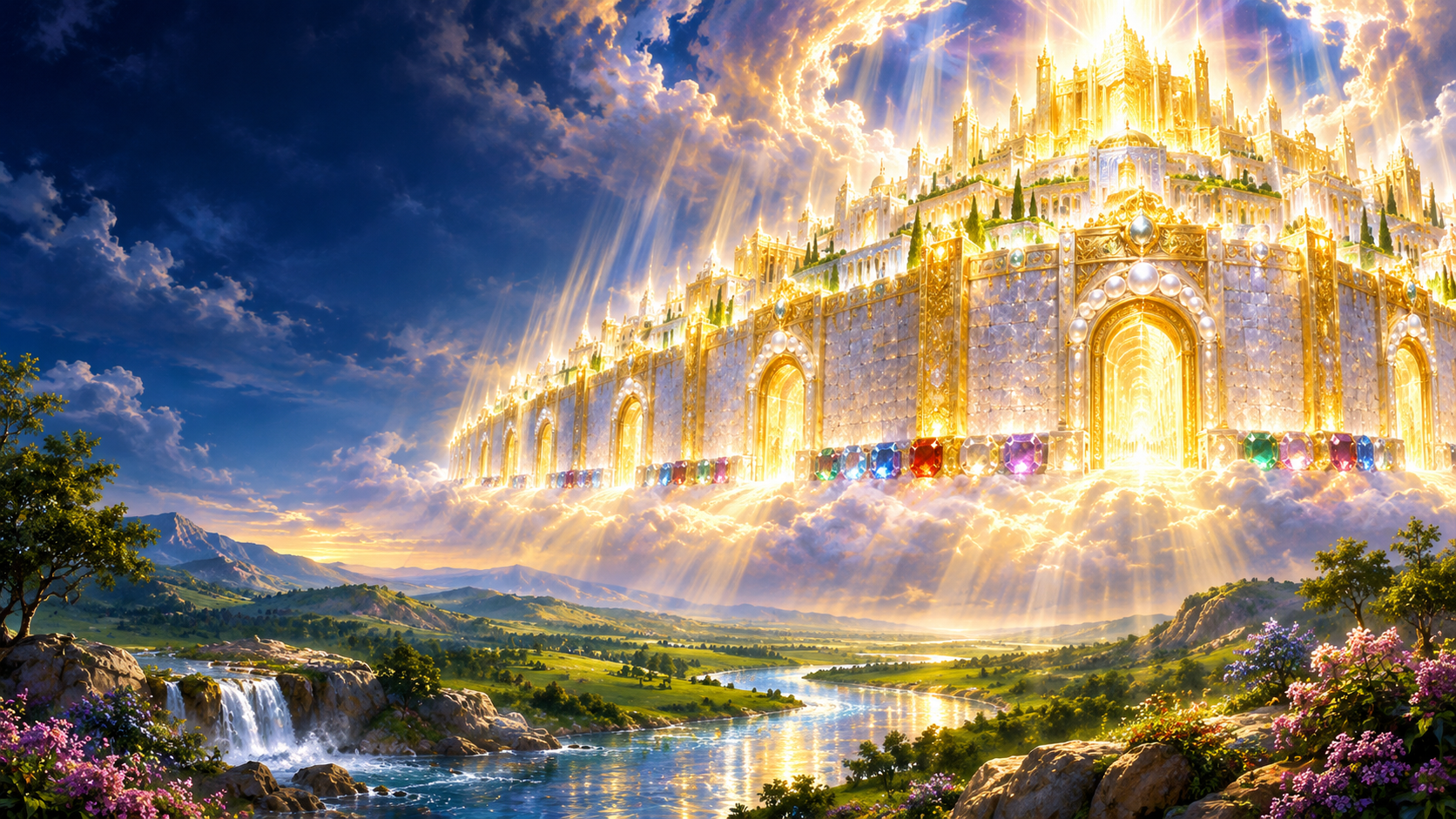
The golden city, jeweled foundations, immense walls, radiant gates, and descending appearance draw upon Revelation 21:9–21.
The painting shows the city suspended above a green valley, surrounded by clouds and heavenly light.
The valley, waterfalls, mountains, towers, domes, and architectural details are artistic choices.
The Bible does not describe the city's exact architectural style.
The illustration also does not establish the city's precise dimensions or show all twelve gates and foundations in their biblical arrangement.
The artwork helps visitors imagine the scale and splendor of John's vision, while the biblical text provides the actual details.
Read Revelation 21:9–21 ↗Scripture opens in a new tab.
John has seen the New Jerusalem, its twelve gates, twelve foundations, precious stones, and streets of gold. Now he discovers something even more extraordinary: the city needs no temple, sun, or moon to illuminate it. Continue into Revelation 21:22–27.
← Previous scene: A New Heaven and a New Earth