
Revelation Journey · Revelation 20:11–15
The Great White Throne Judgment
John sees a great white throne and the One seated upon it. Earth and heaven flee from His presence, and no place is found for them.
Then John sees the dead, great and small, standing before the throne.
Books are opened.
Another book is opened. It is called the Book of Life.
The dead are judged according to what is written in the books, according to their deeds.
The sea gives up the dead who are in it.
Death and Hades also give up the dead who are in them.
Every person is judged according to their deeds.
Then Death and Hades are thrown into the lake of fire.
John calls the lake of fire the second death.
Anyone whose name is not found written in the Book of Life is thrown into the lake of fire.
This is a solemn moment in John's vision. The final judgment has arrived.
But Revelation's story does not end here.
John will next see a new heaven and a new earth.
Who sits upon the great white throne?
Revelation 20:11 describes a great white throne and the One seated upon it, but does not explicitly name the occupant in that verse.
Christians understand this as divine judgment.
Some identify the figure specifically with God the Father.
Others emphasize the New Testament's teaching that judgment has been entrusted to Jesus Christ.
John 5:22 and Acts 17:31 are important passages for understanding Christ's role in judgment.
The central point is that final judgment belongs to God, not to human rulers.
What are the books?
John sees books opened before the throne.
The dead are judged according to their deeds, as recorded in the books.
The passage does not describe their physical appearance or explain how the records are maintained.
The imagery emphasizes that nothing relevant to God's judgment is overlooked.
What is the Book of Life?
The Book of Life is distinguished from the other books opened in the vision.
Revelation describes names being written in the Book of Life.
Revelation 20:15 says anyone not found written in that book is thrown into the lake of fire.
Christians understand the Book of Life in connection with belonging to God and receiving eternal life.
Revelation 21:27 also refers to the Lamb's Book of Life.
Why are people judged by their deeds?
Revelation 20 repeatedly says the dead are judged according to their deeds.
This emphasizes God's knowledge of human actions and the seriousness of moral responsibility.
Other New Testament passages, including Ephesians 2:8–10, teach that salvation is by God's grace through faith and that believers are created for good works.
Christians differ in how they explain the relationship between faith, works, and final judgment.
This exhibit preserves John's statement without claiming that good deeds alone can purchase salvation.
What are Death and Hades?
Death refers to the condition or power of death.
Hades is a biblical term associated with the realm of the dead.
John portrays Death and Hades giving up the dead and then being thrown into the lake of fire.
This represents the end of their role in the vision.
The next chapter announces that death will be no more.
What is the second death?
Revelation 20:14 identifies the lake of fire as the second death.
Earlier, Revelation 20:6 says the second death has no power over those sharing in the first resurrection.
Christians differ on the precise nature and interpretation of final punishment.
The passage nevertheless presents the second death as a grave and final judgment.
Pause and notice
What color is the throne? Who stands before it? What is opened? What is the special book called? What happens to Death and Hades? What comes after this judgment?
Look back at the passage
The throne is white. The dead, great and small, stand before it. Books are opened, including the Book of Life. Death and Hades are thrown into the lake of fire. John next sees a new heaven and a new earth.
Explore the Scripture and artwork
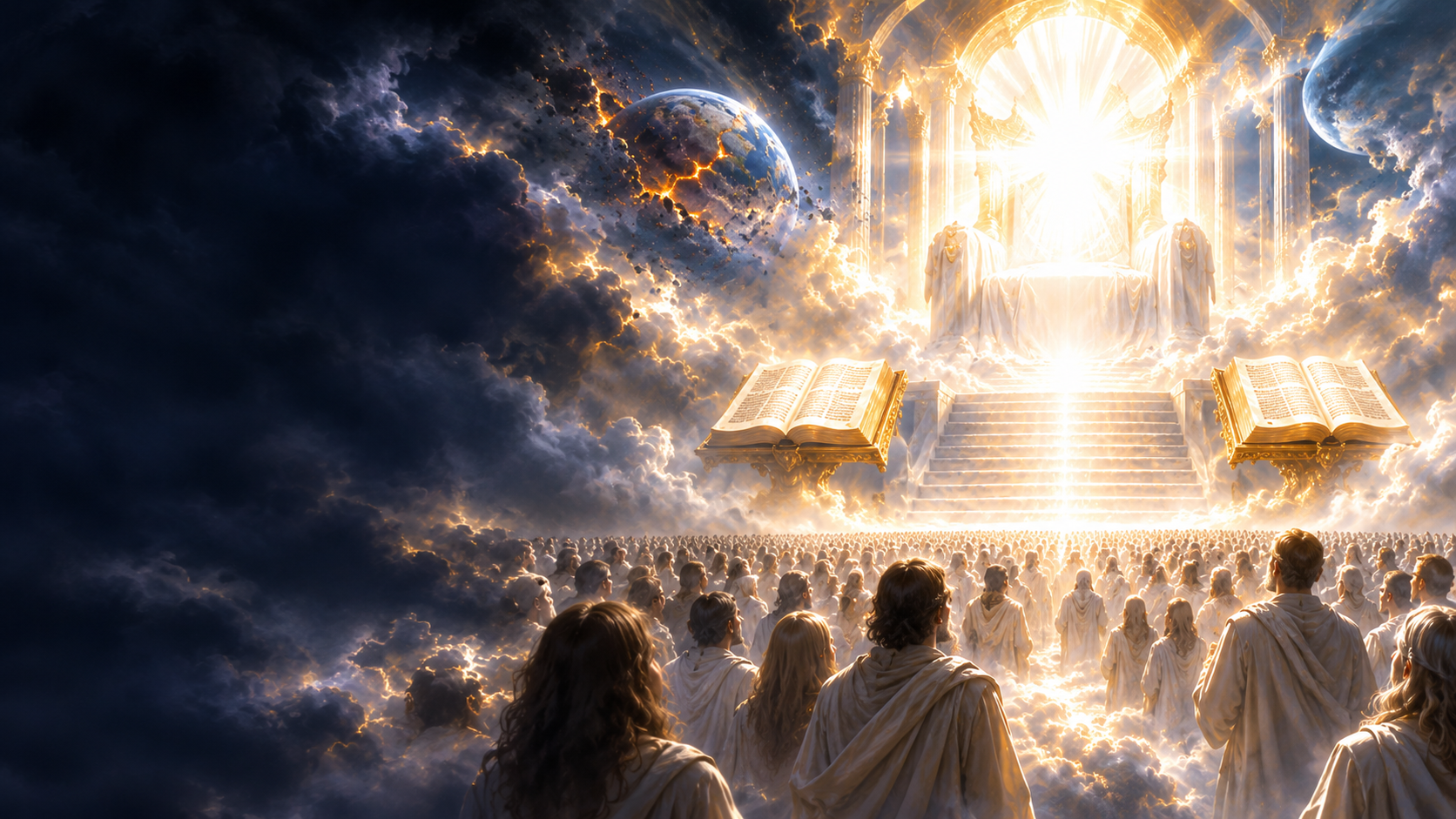
The great white throne, opened books, and gathered dead illustrate Revelation 20:11–15.
The artwork presents an immense radiant throne surrounded by clouds, a heavenly staircase, and people gathered before it.
The staircase, columns, robes, and architectural details are artistic interpretations.
Scripture does not describe the exact appearance of the books or the throne's surroundings.
The dramatic celestial bodies and breaking world in the illustration represent the passage's description of earth and heaven fleeing. They are not a literal account of how that event occurs.
The illustration is intended to help visitors imagine the solemnity of judgment, while the biblical text remains the authority for what John actually saw.
Read Revelation 20:11–15 ↗Scripture opens in a new tab.
The great white throne judgment has been revealed. Now John sees the first heaven and first earth pass away. God announces that He is making all things new. Continue into Revelation 21:1–8.
← Previous scene: Satan's Final Rebellion and Defeat