
Revelation Journey · Revelation 22:1–5
The River of Life and the Tree of Life
The angel shows John a river of the water of life, clear as crystal, flowing from the throne of God and of the Lamb.
The river flows through the middle of the great street of the holy city.
On either side of the river is the Tree of Life.
It bears twelve kinds of fruit, yielding its fruit every month.
The leaves of the tree are for the healing of the nations.
No curse will remain.
The throne of God and of the Lamb will be in the city.
His servants will serve Him.
They will see His face.
His name will be written on their foreheads.
There will be no more night.
They will need no lamp and no light from the sun.
The Lord God will give them light.
And they will reign forever and ever.
The vision that began with warnings, suffering, and conflict now reveals a city filled with life, healing, and God's presence.
The Tree of Life, first encountered in the Garden of Eden, appears again in the final chapter of Revelation.
What humanity lost in the beginning is now presented in a vision of restoration.
Where does the river come from?
Revelation 22:1 says the river flows from the throne of God and of the Lamb.
The river is described as clear as crystal.
Its source connects the water of life directly with God's presence.
The image recalls Ezekiel 47, where water flows from the temple and brings life wherever it goes.
What is the Tree of Life?
The Tree of Life first appears in Genesis 2:9 in the Garden of Eden.
After humanity's disobedience, Genesis 3:22–24 describes access to the Tree of Life being guarded.
In Revelation 22, the Tree of Life appears again in the holy city.
Its presence connects the Bible's opening chapters with its final vision of God's restored creation.
Is there one tree or more than one?
Revelation 22:2 describes the Tree of Life on either side of the river.
The language has led to different interpretations of how the tree is positioned.
Some imagine a single extraordinary tree extending across the river.
Others understand the description as trees growing along both banks, sharing the identity of the Tree of Life.
The passage emphasizes the tree's life-giving fruit and healing leaves, rather than explaining its botanical structure.
Why does the tree produce twelve kinds of fruit?
John says the Tree of Life bears twelve kinds of fruit, yielding fruit every month.
The number twelve appears repeatedly in Revelation's description of the New Jerusalem.
The twelve fruits suggest abundance and continuing provision.
The passage does not identify the fruits by their earthly names.
It also does not explain precisely how months are measured in a city that needs no sunlight.
Why do the nations need healing?
Revelation 22:2 says the leaves of the Tree of Life are for the healing of the nations.
The previous chapter declares that death, mourning, crying, and pain will be no more.
Christians differ on how to understand healing in a creation where suffering has ended.
Some interpret the leaves as a symbol of complete restoration and enduring well-being.
Others understand the imagery as describing God's continuing provision of life and wholeness.
The passage does not explicitly describe sickness continuing in the New Jerusalem.
What does it mean that the curse is gone?
Revelation 22:3 declares that there will be no more curse.
This recalls Genesis 3, where humanity's disobedience brought consequences into the world.
In the New Jerusalem, the curse no longer remains.
God's servants worship and serve Him, see His face, and belong to Him.
The vision presents restored fellowship between God and His people.
What does seeing God's face mean?
Revelation 22:4 promises that God's servants will see His face.
In Exodus 33:20, God tells Moses that a human cannot see His face and live.
Revelation's final vision presents a transformed relationship in which God's servants see Him.
Christians often connect this promise with the hope of direct fellowship with God, sometimes called the beatific vision.
What does God's name on their foreheads mean?
John says God's servants will have His name on their foreheads.
Revelation previously uses marks and names to identify allegiance and belonging.
Revelation 14:1 describes the Lamb standing with those who bear His name and His Father's name on their foreheads.
Here the name communicates that God's servants belong to Him.
Pause and notice
Where does the river of life begin? What grows beside the river? How many kinds of fruit does the tree bear? What are its leaves for? What will be gone forever? Whose face will God's servants see?
Look back at the passage
The river flows from the throne of God and the Lamb. The Tree of Life grows beside it. The tree bears twelve kinds of fruit. Its leaves are for the healing of the nations. The curse will be no more. God's servants will see His face.
Explore the Scripture and artwork
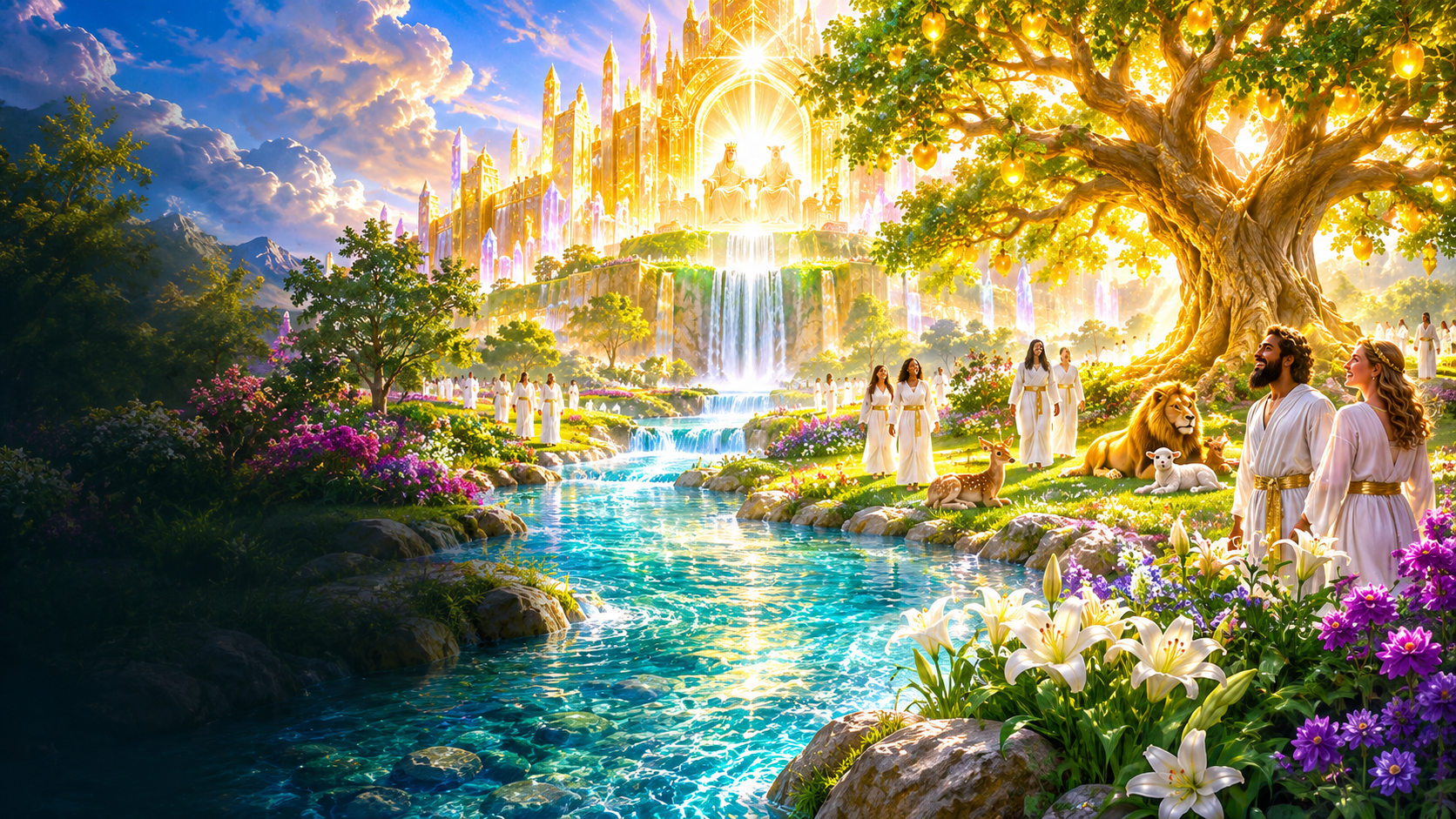
The crystal-clear river, magnificent tree, golden city, and radiant heavenly light illustrate themes from Revelation 22:1–5.
The river represents the water of life flowing from the throne of God and the Lamb.
The great tree represents the Tree of Life.
Its golden fruit, broad branches, and extraordinary size are artistic choices.
Scripture specifies twelve kinds of fruit and leaves for the healing of the nations, but does not describe their precise appearance.
The people, animals, architecture, waterfalls, and surrounding gardens are also artistic interpretations.
Revelation 22:1–5 does not specifically describe these animals or the exact landscape around the river.
The painting helps visitors imagine the beauty and peace of the final vision, while Scripture remains the authority for what John saw.
Read Revelation 22:1–5 ↗Scripture opens in a new tab.
John has seen the River of Life, the Tree of Life, and the end of the curse. God's servants will see His face and reign forever. Now the final words of Revelation bring Jesus' promise, an invitation, and a closing blessing. Continue into Revelation 22:6–21.
← Previous scene: The Glory of God Illuminates the City