
Revelation Journey · Revelation 17:7–14
The Angel Explains the Mystery
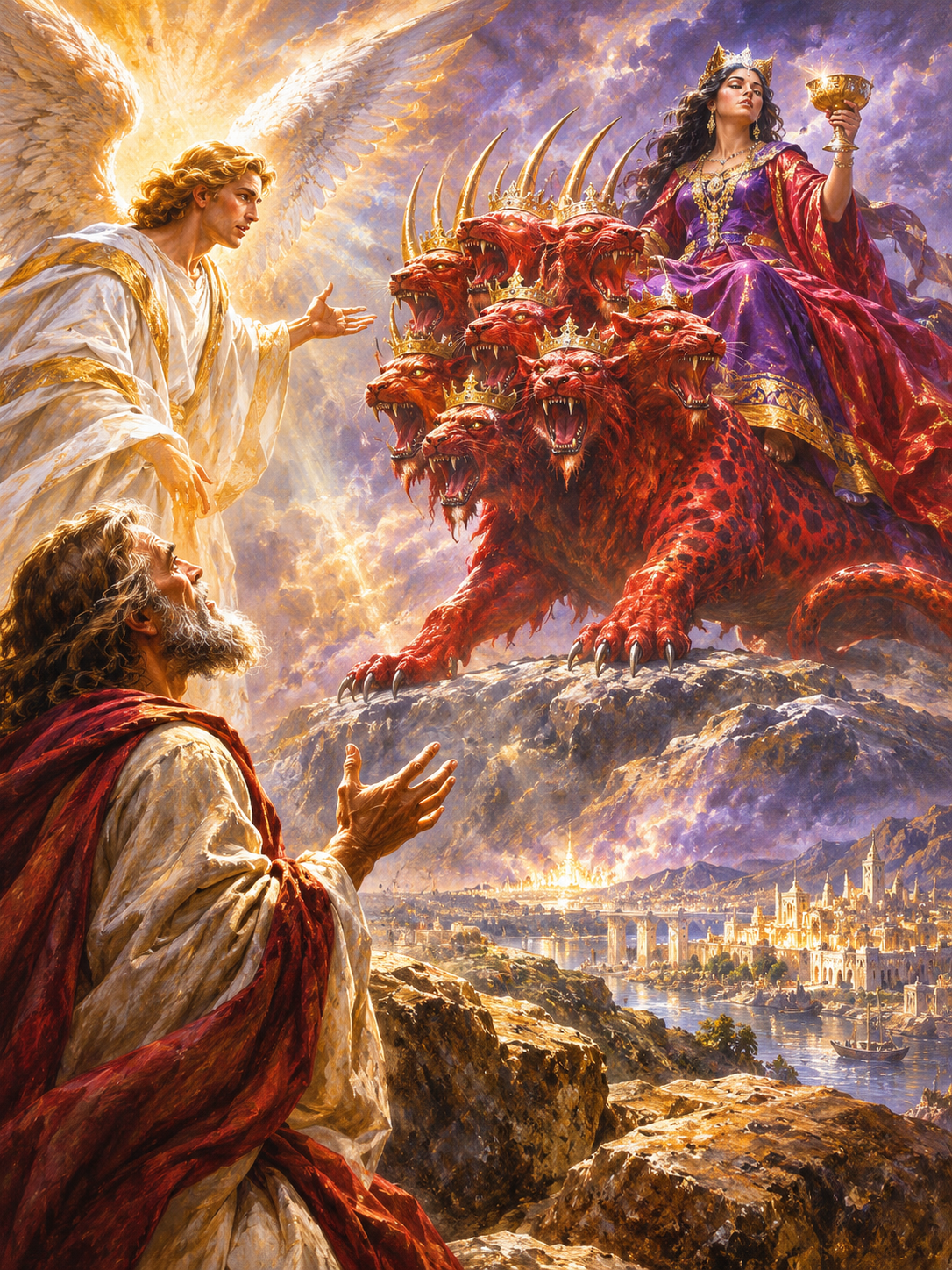
The angel asks John, “Why do you wonder?” He promises to explain the mystery of the woman and the beast that carries her, with its seven heads and ten horns.
The angel describes a beast that once was, now is not, and will rise from the abyss before going to destruction.
People whose names are not written in the Book of Life will marvel when they see the beast.
The seven heads represent seven mountains upon which the woman sits. They also represent seven kings.
Five kings have fallen. One is. Another has not yet come, and when he comes, he must remain for a little while.
The beast is described as an eighth king, belonging to the seven, yet moving toward destruction.
The ten horns represent ten kings who have not yet received a kingdom. They receive authority with the beast for one hour.
These rulers share one purpose. They give their power and authority to the beast.
Together they make war against the Lamb. But the Lamb overcomes them, because He is Lord of lords and King of kings.
Those who are with Him are called, chosen, and faithful.
What do the seven heads mean?
The angel gives two descriptions. The heads represent seven mountains and seven kings.
Mountains can be associated with places of power. Kings represent rulers or governing authority.
Some interpreters connect the seven mountains with ancient Rome. Others understand the seven kings as successive rulers or kingdoms.
Revelation does not provide an undisputed modern list identifying all seven kings. The exhibit does not assign specific present-day leaders to these symbols.
What do the ten horns mean?
The angel identifies the ten horns as ten kings.
They receive authority alongside the beast for a short period described as one hour.
Their shared purpose is to give their power and authority to the beast.
The passage does not identify these kings by modern names or countries.
Why does the Lamb overcome them?
The Lamb represents Jesus Christ. Revelation repeatedly uses this title for Him.
The rulers oppose the Lamb, but they cannot defeat Him. He is called Lord of lords and King of kings.
The passage also describes those who are with Him as called, chosen, and faithful.
The message is not that earthly power lasts forever. The Lamb's victory stands above the authority of kings.
Pause and notice
What do the seven heads represent? What do the ten horns represent? Who receives the rulers' authority? Who overcomes them?
Look back at the passage
The seven heads represent seven mountains and seven kings. The ten horns represent ten kings. They give authority to the beast. The Lamb overcomes them.
Explore the Scripture and artwork
The angel explaining the vision to John comes from Revelation 17. The seven heads, ten horns, and scarlet beast are biblical imagery.
The angel's appearance, John's clothing, the landscape, and the lighting are artistic choices.
The artwork brings together the explanation and the vision of the beast. It is not intended to identify historical or modern rulers.
Read Revelation 17:7–14 ↗Scripture opens in a new tab.
The angel has explained the beast and its rulers. Now John learns what happens when the beast and its allies turn against the woman. Continue into Revelation 17:15–18.
← Previous scene: The Woman on the Scarlet Beast