
Revelation Journey · Revelation 19:17–21
The Beast and False Prophet Are Defeated
John sees an angel standing in the sun. The angel calls loudly to the birds flying high in the sky, inviting them to gather for the great supper of God.
The angel announces a terrible judgment. The birds are summoned to consume the flesh of defeated kings, commanders, mighty warriors, horses, riders, and people of every rank.
Then John sees the beast, the kings of the earth, and their armies gathered together for war.
They prepare to fight against the rider on the white horse and His heavenly army.
But their rebellion cannot succeed.
The beast is captured. With him, the false prophet is also captured.
The false prophet had performed signs in the beast's presence. Through those signs, he deceived people into receiving the mark of the beast and worshiping its image.
Both the beast and the false prophet are thrown alive into the lake of fire burning with sulfur.
The remaining armies are killed by the sword proceeding from the mouth of the rider on the white horse.
The birds gather over the battlefield, completing the grim scene John describes.
The beast's power has come to an end. The false prophet's deception has failed. Neither can overcome the rider called Faithful and True.
Who is the beast?
The beast is the powerful opponent of God introduced earlier in Revelation 13.
It receives authority, inspires worship, and makes war against God's people.
Christians interpret the beast differently. Some understand it in relation to ancient imperial power. Others expect a future ruler or kingdom.
Revelation 19 describes the beast's defeat without identifying a present-day individual.
Who is the false prophet?
The false prophet is associated with the second beast described in Revelation 13.
He performs deceptive signs and leads people to worship the beast and its image.
The false prophet's role is to support the beast's authority through deception.
His defeat shows that impressive signs do not necessarily establish truth or divine authority.
What is the lake of fire?
Revelation describes the beast and false prophet being thrown alive into a lake of fire burning with sulfur.
The lake of fire appears again in Revelation 20, where it is connected with final judgment.
Christians differ on the precise nature of the imagery and its relationship to eternal punishment.
The passage presents the lake of fire as a place or image of severe divine judgment.
What is the great supper of God?
The angel calls birds to gather for the great supper of God.
This is not the same celebration as the marriage supper of the Lamb.
The marriage supper is a scene of blessing and rejoicing.
The supper described here is a grim picture of judgment upon defeated armies.
The imagery recalls the judgment scene in Ezekiel 39:17–20.
Why does the sword come from His mouth?
The sword comes from the mouth of the rider called Faithful and True.
It represents His powerful word and authority to execute judgment.
The image emphasizes that His victory does not depend upon an ordinary earthly weapon.
Pause and notice
Who calls the birds to gather? Who gathers for war against the rider? What happens to the beast and false prophet? What defeats the remaining armies?
Look back at the passage
An angel standing in the sun calls the birds. The beast and kings gather their armies. The beast and false prophet are thrown into the lake of fire. The remaining armies are defeated by the sword proceeding from the rider's mouth.
Explore the Scripture and artwork
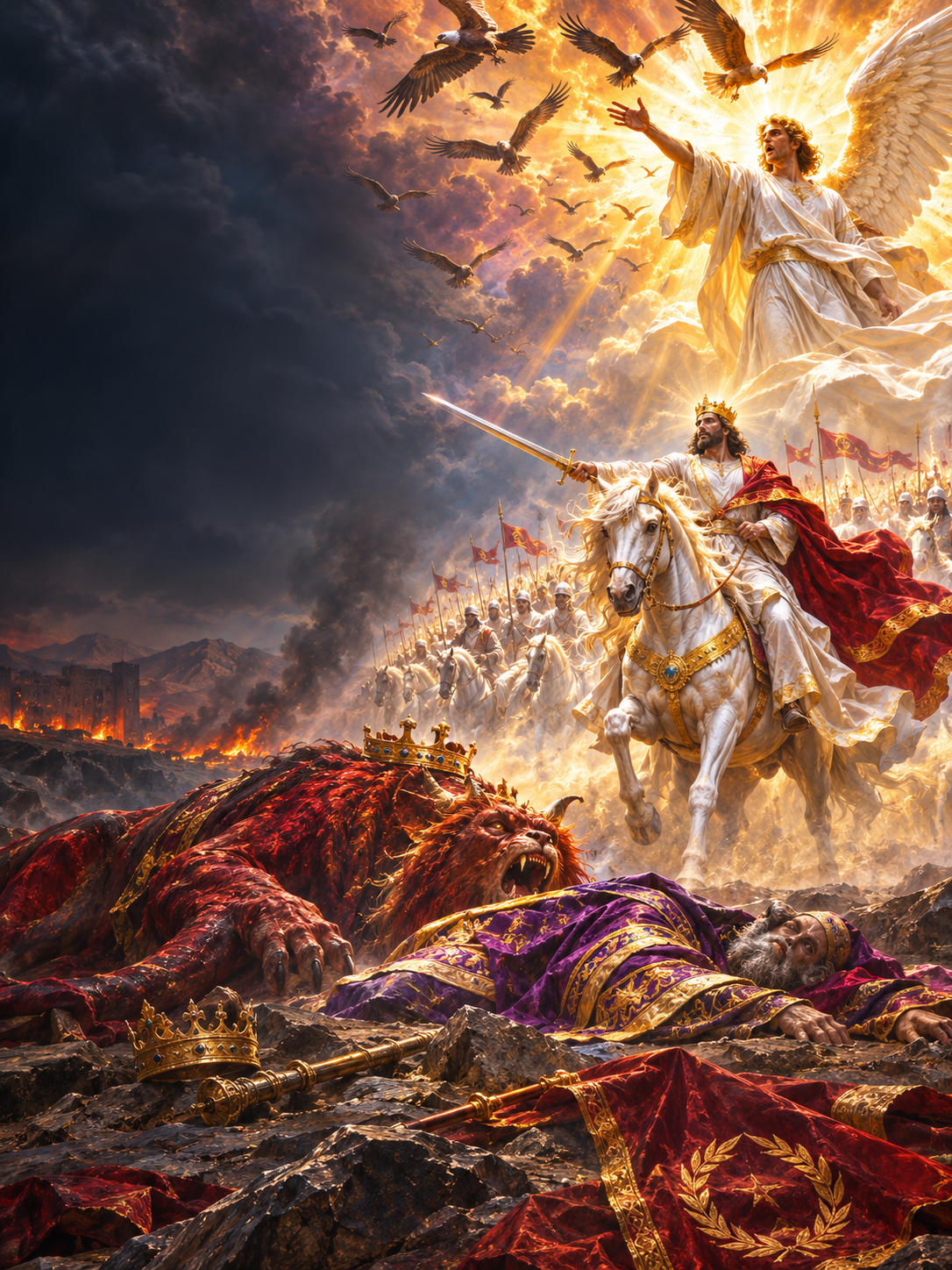
The heavenly rider, gathering birds, beast, false prophet, and defeated armies draw upon Revelation 19:17–21.
The illustration combines several moments into one scene. The exact appearance of the beast, false prophet, battlefield, and armies is artistic interpretation.
The artwork portrays the beast and false prophet fallen before the rider. Scripture describes their capture and their being thrown into the lake of fire. The painting does not depict every stage of that judgment.
The rider's handheld sword is an artistic choice. Scripture specifically describes the sword proceeding from His mouth.
This scene depicts severe judgment without reproducing the graphic details of the battlefield.
Read Revelation 19:17–21 ↗Scripture opens in a new tab.
The beast and false prophet have been defeated. But Revelation's account continues with the dragon, the ancient serpent called the Devil and Satan. An angel descends with a key and a great chain. Continue into Revelation 20:1–3.
← Previous scene: Faithful and True — The Rider on the White Horse